Why AI Didn't Replace Software Engineers
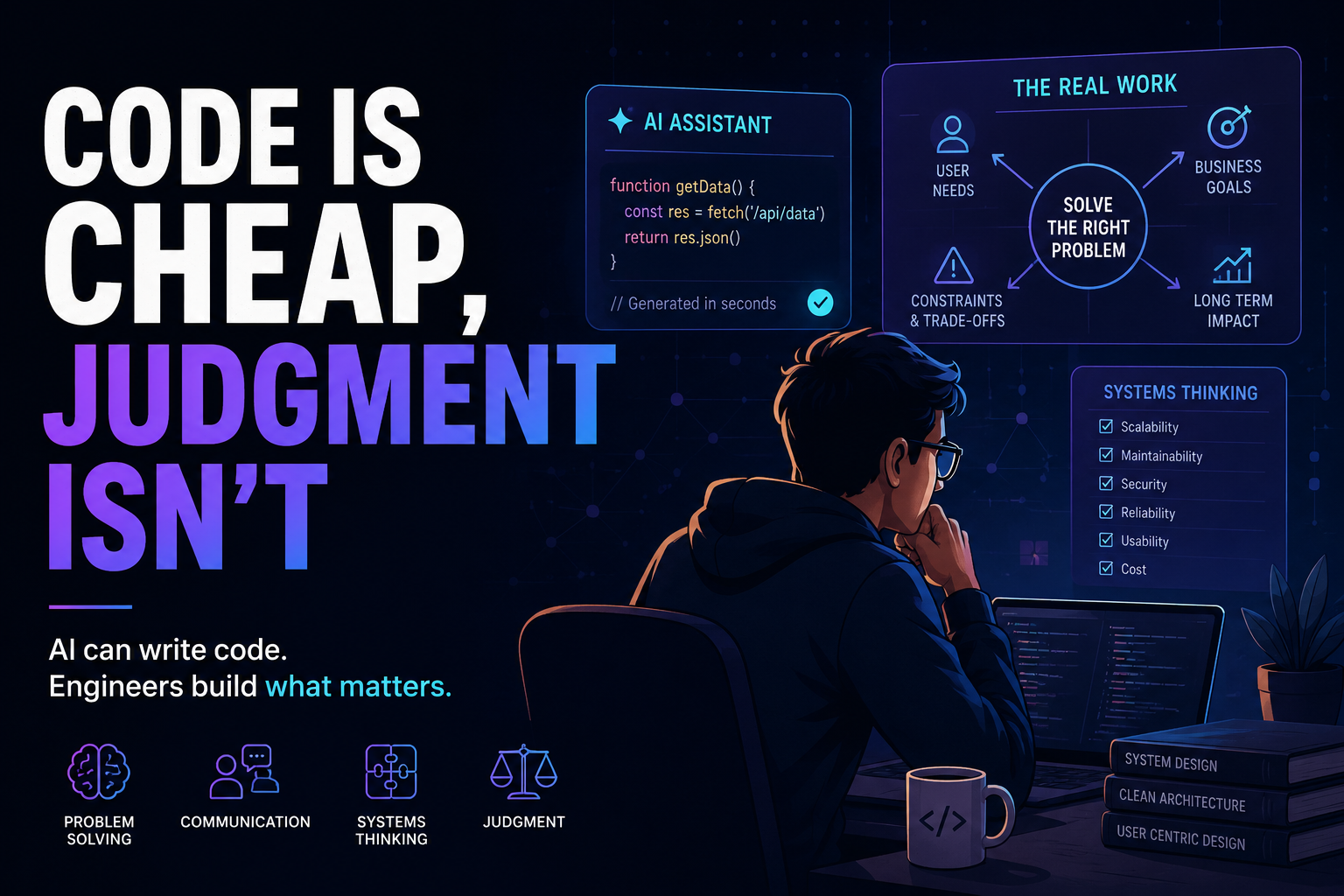
Code Is Cheap, Judgment Isn't
AI coding assistants and autonomous agents have fundamentally changed how software is built. In 2026, machines can generate components, write tests, refactor legacy systems, and produce working prototypes in minutes.
Yet despite all this progress, one thing has become increasingly obvious:
Software development was never about writing syntax.
Code is simply the medium. The real work has always been understanding problems, making decisions, and designing systems that create value.
Understanding Beats Memorization
Experienced developers rarely remember code line by line.
Instead, they recognize patterns.
Where beginners see syntax, experienced engineers see:
- Data flow
- State management
- Business rules
- System boundaries
- Trade-offs and constraints
Programming languages change constantly. The underlying concepts survive.
This is why developers can move between technologies throughout their careers. They are not memorizing tools. They are building mental models.
Software Engineering Is a Learning Discipline
Frameworks rise and fall.
Languages evolve.
Entire ecosystems appear and disappear.
The most valuable engineers are not the ones who know the most APIs. They are the ones who can adapt, learn quickly, and apply experience in unfamiliar environments.
After learning one language, learning the next becomes easier.
Experience compounds.
The Hardest Question Isn't "How"
AI is becoming increasingly good at answering:
How do I build this?
But software engineering has always revolved around a different question:
Should we build this at all?
Defining the problem is often harder than implementing the solution.
Real projects involve:
- Unclear requirements
- Conflicting priorities
- Business constraints
- Technical debt
- Future maintenance costs
Engineering is as much about decision making as it is about implementation.
Modern Software Is Systems Engineering
Applications today are assembled from:
- APIs
- Databases
- Cloud infrastructure
- Open source packages
- Third-party services
- AI models
Success is no longer measured by how much code you write.
It is measured by how effectively you combine these pieces into something reliable, maintainable, and useful.
AI Is Another Layer of Abstraction
Every generation of developers works at a higher level than the one before it.
Assembly became high-level languages.
Frameworks removed boilerplate.
Cloud platforms abstracted infrastructure.
AI is simply the next step.
Abstraction has never eliminated software engineering.
It has only changed where humans spend their creativity.
Judgment Is the Scarce Resource
AI can generate solutions.
Humans determine whether those solutions are correct.
AI can write code.
Humans decide what should exist.
AI can optimize patterns.
Humans invent them.
The value of software engineers has never been their typing speed.
It comes from:
- Systems thinking
- Communication
- Empathy for users
- Understanding trade-offs
- Making good decisions under uncertainty
These skills are difficult to automate because they depend on context, experience, and human judgment.
Software Exists to Create Value
Code is not the goal.
Code is a tool.
The purpose of software is to solve problems, enable creativity, and improve how people live and work.
As AI continues to reshape the industry, perhaps the more interesting questions are no longer:
Can machines write code?
Instead, we should ask:
- What can people create with these tools?
- What opportunities do they unlock?
- What risks do they introduce?
- How do we ensure technology serves people?
Because software development has never been about syntax.
And in the age of AI, that truth has become more obvious than ever.
Keep reading